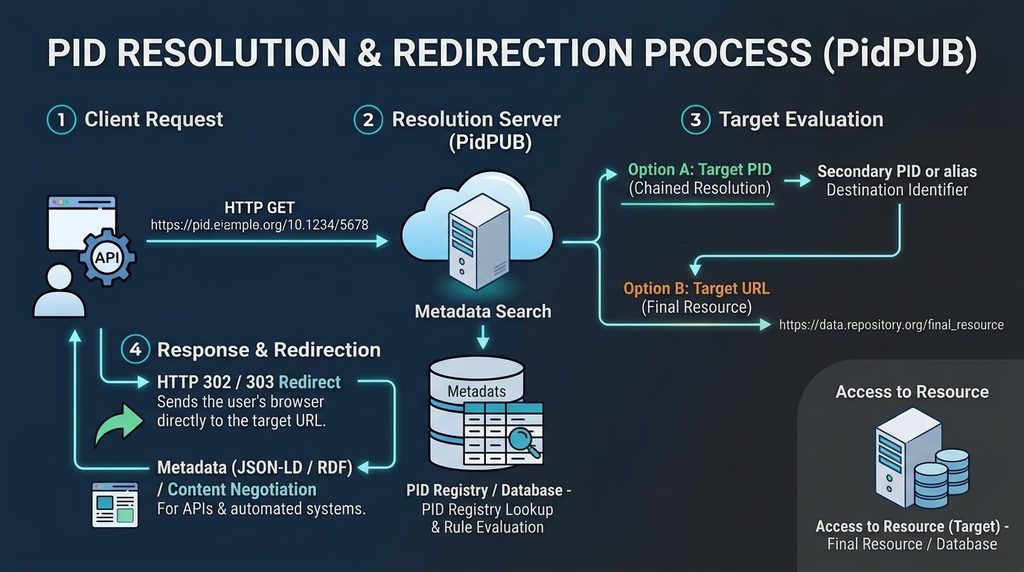
The mental map illustrates the step-by-step technical workflow involved in resolving a CODEX identifier into other widely recognized Persistent Identifiers (PIDs) to ensure seamless access to digital resources. The process is broken down into five main stages:
1. Input & Detection
- Original CODEX ID: The process begins when the system receives a CODEX identifier (e.g.,
codex:12345). - Syntax Analysis: The system performs validation checks on the input string to detect its structure and extract embedded metadata.
- CODEX Central System Query: A query is sent to the central registry to identify existing relationships, mappings, and metadata associations for that specific identifier.
2. Translation / Mapping
- Mapping Service (Crosswalks): The system translates CODEX-specific metadata into standardized PID formats.
- Equivalence Table / Database: It consults a centralized or distributed mapping database to find the precise, unique equivalents between the CODEX ID and target PIDs.
3. Redirection & Resolution (Target PID)
In the context of Persistent Identifiers (PID) and PID Publication (PidPUB) architectures or persistent identifier management platforms (such as Accurids or Handle/DOI resolvers), the Redirection & Resolution mechanism links a persistent identifier to its actual physical or virtual entity via a Target PID or Target URL.
Key Concepts
- PID (Persistent Identifier): The permanent reference (PID) assigned to a scientific or business resource or entity.
- Resolution: The technical process by which a client requests to resolve the PID and the system searches for the corresponding metadata record or mapping rule.
- Redirection: The HTTP behavior (typically via
302 Foundor303 See Otherresponses) that redirects the user or consumer system from the resolver to the final destination. - Target PID / Target URL: The identifier or actual destination address to which the current PID points. If the original resource changes its location on the web or is merged with another object, only the Target is updated, while the publicly exposed PID remains unchanged.
4. Resolution Flow to Target PID
- Client Request: A user or service sends an HTTP request to the PID resolver’s URL.
- Redirection Lookup: The resolution engine (PidPUB) queries its central registry or metadata database to find the rule associated with
the authority ID. - Target Mapping:
- Direct Target URL: Redirects directly to the endpoint or HTML page of the final resource.
- Target PID (Chain Resolution): If the assigned destination is another PID (due to an alias, duplication, or migration), the system internally resolves the Target PID before issuing the final redirect or returning structured data.
- HTTP Response:
- Browser Redirection: Returns an HTTP 302/303 response indicating the
Location: <Target_URL>header. - Content Negotiation: If the
Acceptheader requestsapplication/jsonorapplication/ld+json, the resolver directly delivers the entity’s structured metadata without performing the visual redirection.
- Browser Redirection: Returns an HTTP 302/303 response indicating the
5. Technical Infrastructure
The underlying technology supporting this workflow includes:
- Resolver Server: Executes the redirection using standard web protocols like HTTP 302 (Found/Temporary) or HTTP 301 (Moved Permanently).
- Query APIs: Exposes endpoints through REST, GraphQL, or JSON-LD to handle query traffic.
- Distributed Databases / Cache: Ensures high availability, redundancy, and fast response times through caching and distributed networks.
6. Final Result (User)
- The user is automatically redirected to the final accessible URL where the resource is hosted.
- They gain access to the enriched metadata associated with the PID.
- The process ensures long-term link persistence, effectively preventing broken links or 404 errors.